Senate Summons Education Minister, WAEC Head Over Abrupt 2025/2026 SSCE Curriculum Changes

The Senate has summoned the Minister of Education, Tunji Alausa, and the Head of WAEC’s National Office, Amos Dangut, to explain the sudden introduction of new guidelines for the 2025/2026 Senior Secondary Certificate Examination (SSCE). The call followed a motion raised by Sunday Karimi (APC, Kogi West) during plenary on Tuesday. Karimi expressed concern that the changes had abruptly altered subject requirements for students preparing for the May/June 2025/2026 exams. He said the new guidelines, which added extra subjects to the curriculum, were being imposed on SS3 students who had not been adequately prepared. According to him, the directive effectively requires current SS3 students to follow a curriculum meant for SS1 students, originally scheduled to take effect in 2027/2028. “This means each SS3 student will be required to take two or three additional subjects in the upcoming exams, despite having never been taught the courses and lacking sufficient preparation,” Karimi explained. Lawmakers backed the motion, warning against the hasty implementation. Senator Adams Oshiomhole questioned the readiness of teachers and laboratories, saying, “For a new subject to start, citizens should be well-informed and prepared. There is no evidence of that. We should not plan in a way that will bring embarrassment to the country.” Idiat Adebule (Lagos West) called for a full investigation, noting that such decisions typically involve the National Council on Education. Solomon Adeola (Ogun West) added that students should not be tested on subjects they have not been properly taught. After deliberations, the Senate resolved to summon the Minister of Education for a public hearing with the Senate Committee on Basic and Secondary Education. It also recommended that the Federal Government and WAEC exempt current SS3 students from writing the 2026 exams under the new curriculum, stating that the updated guidelines should only apply to students currently in SS1.

Read More

WAEC Shifts Full Computer-Based Exams to 2027, Announces 2026 Test-Run Phase

The West African Examinations Council (WAEC) has postponed the full adoption of computer-based testing (CBT) for the Senior School Certificate Examinations (SSCE) to 2027, instead of 2026 as earlier directed by the federal government. The 2026 May/June WASSCE will now serve as a pilot phase, allowing students to choose between the traditional paper-and-pen format and CBT. Hajia Binta Abdulkadir, Chairman of WAEC’s Nigeria National Committee (NNC) and Federal Government nominee, revealed the update during the opening session of the committee’s 63rd annual meeting in Umuahia, Abia State. She assured stakeholders that no candidate would be disadvantaged during the transition, emphasizing WAEC’s commitment to a smooth migration to CBT. Abdulkadir highlighted several initiatives to prepare students for the digital exams, including training senior school students on tablet use and answering essay questions digitally. She also addressed concerns about subject selection under the revised Basic and Secondary School Curricula, clarifying that students are free to choose subjects across different streams. Science students, for example, can still take Economics as an elective, and the period for uploading Continuous Assessment Scores (CASS) has been extended to ensure accurate recording. The event also celebrated outstanding performers in the 2024 May/June school-based exams. Master Ajisafe Qoreebullah Olamilekan of Eemaan Foundation College, Osogbo, Osun State, emerged as the overall best candidate nationwide, scoring 580.8535 points with A1 grades in eight subjects. He is now studying Medicine and Surgery at the Federal University of Health Sciences, Ila Orangun. The second- and third-best students, Joan Eberechukwu Onovo and Chibukem Mac-Donald Mbah, were similarly honoured. Like Ajisafe, both are pursuing degrees in Medicine and Surgery at the University of Lagos and Afe Babalola University, respectively. All three top performers attended private schools. WAEC also recognised exceptional visually impaired candidates, awarding Master Ugwu Christian Chiemerie and Miss Abiodun Taye Olubunmi for their achievements. Christian, from the College of Immaculate Conception, Enugu, scored 413.5326 points and is now studying Law at the University of Nigeria, Nsukka. Taye, from Queen’s College, Lagos, scored 429.1543 points and is currently studying Guidance and Counselling at the University of Ilorin. Abia State Governor Alex Otti, represented by the Commissioner for Basic and Secondary Education, Elder Goodluck Chinedu Ubochi, praised WAEC for its role in promoting credible examinations and safeguarding assessment integrity. He described the council’s efforts to curb malpractice as “timely, courageous, and essential to protect the future of our young ones.” Dr Amos Dangut, Head of WAEC Nigeria, noted that the awards encourage healthy competition and academic excellence nationwide, congratulating students, their schools, and parents. Hajia Abdulkadir also commended all awardees and reaffirmed the federal government’s support for WAEC, assuring that Nigerian students would continue to be globally competitive.

Read More

House Orders Immediate Halt To WAEC 2026 Computer-Based Exams Over Student Safety Concerns

The House of Representatives has ordered the immediate suspension of the West African Examinations Council’s (WAEC) plan to introduce Computer-Based Testing (CBT) for the 2026 West African Senior School Certificate Examination (WASSCE). Lawmakers warned that implementing the exams prematurely could trigger mass academic failures, psychological stress, and even endanger students’ lives. The directive followed a motion of urgent public importance by Hon. Kelechi Nworgu during Thursday’s plenary, who described the proposed rollout as a looming educational disaster. While noting the success of CBT in the Joint Admissions and Matriculation Board (JAMB), Nworgu highlighted that most Nigerian secondary schools are ill-prepared for a similar transition. Many schools, particularly in rural areas, lack computers, trained ICT teachers, stable electricity, and internet access. “Most of the over 25,500 schools nationwide, especially in rural communities, have no functional computer systems or trained teachers. Many students have never used a computer, yet they are expected to take up to nine subjects via CBT,” he said. Nworgu warned that rushing the initiative could result in widespread failure, frustration, and potential mental health challenges or substance abuse among students. He recommended that WAEC delay CBT implementation for at least three years, targeting 2029 or 2030 once adequate infrastructure and training are in place. The House directed WAEC and the Federal Ministry of Education to immediately halt the planned 2026 CBT exams. It also urged the government to allocate funds in the 2026 budget for hiring computer teachers, building ICT laboratories, and installing standby generators in schools nationwide. Additionally, the House tasked its Committees on Basic Examination Bodies, Digital and Information Technology, Basic Education and Services, and Labour, Employment and Productivity to engage stakeholders and submit a detailed report within four weeks to guide future legislative action.

Read More

WAEC Releases 2025 WASSCE Results, Records Worst Performance in Recent History

By Kamal Yalwa: Lagos, Nigeria — August 4, 2025 The West African Examinations Council (WAEC) on Monday officially released the results of the 2025 May/June West African Senior School Certificate Examination (WASSCE) in Lagos, revealing a dramatic decline in candidate performance. Speaking at a press briefing held at WAEC’s national office in Yaba, Lagos, the Head of the National Office (HNO), Dr. Amos Dangut, disclosed that only 754,545 candidates, representing 38.32% of the total 1,969,313 who sat for the exam, obtained credits and above in at least five subjects including English Language and Mathematics. This marks a staggering 33.8% drop from the 72.12% pass rate recorded in 2024, making it the poorest performance in recent history for this school-based examination. The exam, conducted over eight weeks and one day, was marred by controversy—particularly regarding the English Language paper, which many candidates were reportedly forced to write late at night due to logistical delays. There were widespread calls for a review or cancellation of the affected paper. Gender Distribution & Special Needs Candidates Of the total candidates, 976,787 (49.60%) were male and 992,526 (50.40%) female, showing a slight female majority in participation. WAEC also confirmed that results of all 12,178 candidates with special needs—including 112 visually impaired, 615 hearing impaired, and 37 physically challenged—were successfully released along with the general results. Withheld Results & Exam Malpractice WAEC further revealed that the results of 192,089 candidates (9.75%) are being withheld due to alleged involvement in exam malpractice, currently under investigation. This figure reflects a decline from the 11.92% recorded in 2024, which the council attributed to the introduction of Computer-Based Testing (CBT) in select subjects, including English Language, Mathematics, Biology, and Economics. Dr. Dangut emphasized that the council is intensifying its crackdown on malpractice, warning that not only students but also schools, supervisors, invigilators, and administrators found guilty will face sanctions. He lamented that many students now rely on “expo” and rogue websites for leaked questions rather than preparing adequately. Unpaid Fees & Result Access WAEC also noted that results of candidates sponsored by state governments that have not yet settled examination fees will not be released until payment is received. However, all other candidates can begin checking their results within the next 12 hours via www.waecdirect.org and download digital certificates through the WAEC website using their Smart Identity Cards. Physical certificates will be sent to schools at a later date. Dr. Dangut expressed appreciation to the Federal Government, state ministries of education, security agencies, and examination officials for their cooperation in executing this year’s exam despite widespread economic challenges. He also noted that the cost of administering the exams had risen sharply due to inflation, fuel prices, and increased cost of materials.


Read More

FG Directs WAEC NECO to Fully Adopt Computer-Based Testing by 2026

The federal government has directed major examination bodies, including the West African Examinations Council (WAEC) and the National Examinations Council (NECO), to transition fully to Computer-Based Testing (CBT) by 2026. Minister of Education, Prof. Tahir Mamman, issued the directive during a meeting with chief executives of examination bodies in Abuja. He emphasized the need for Nigeria’s assessment systems to align with global best practices and improve efficiency, credibility, and transparency in national examinations. Prof. Mamman noted that while the Joint Admissions and Matriculation Board (JAMB) has successfully implemented CBT for years, it is time for other examination bodies to follow suit. “This move will modernize our examination system and ensure Nigerian students are competitive globally,” he stated. The Minister urged the bodies to begin preparations immediately, including upgrading technical infrastructure, training personnel, and sensitizing students and parents ahead of the 2026 rollout.

Read More

Edo Governor-elect Okpebholo’s WAEC certificate surfaces 

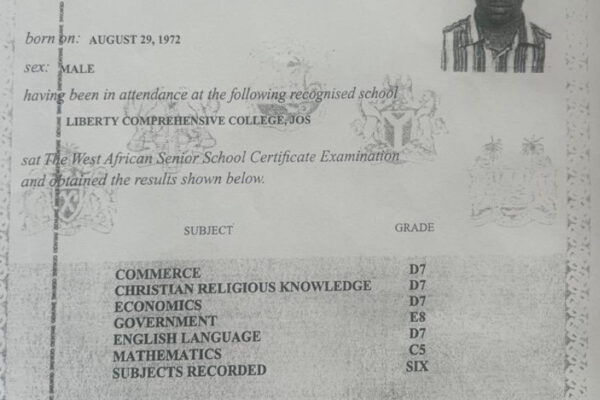
The West Africa Examination Council (WAE) certificate of the Edo State Governor-elect Senator Monday Okpebholo is in public domain. Trendbrio.com can report.  The West African Senior School Certificate now on various social media platforms, was issued in June 2008.  Meanwhile, Okpebholo was born on August 29, 1972 and attended Liberty Comprehensive College, Jos as stated on the SSCE certificate.  The Serving Senator, according to the breakdown on the certificate failed five subjects out of six.  The breakdown is as follows;  Commerce -D7  Christian Religious Knowledge-D7 Economics-D7 Government-D7 English Language-D7 Mathematics-C5  Okpebholo’s candidate number is 4320545182 while the Certificate number is 11023655.  The All Progressive Congress candidate was declared as the winner of the election by the Independent National Electoral Commission (INEC) on Sunday.  Okpebholo polled a total of 291,667 votes to defeat Peoples Democratic Party (PDP) with 247, 274 votes. 

Read More