War Powers Act in Focus as Trump Hints at Possible Strike on Iran

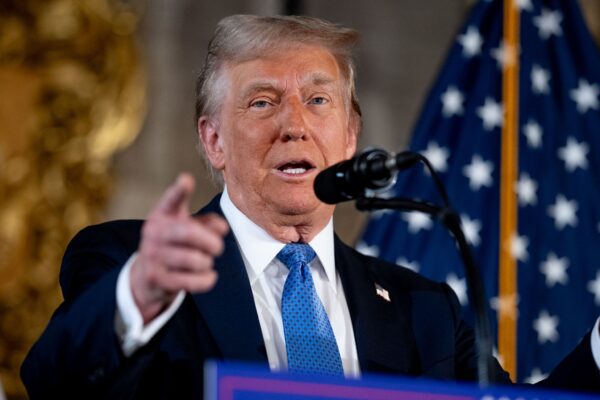
As tensions escalate in the Middle East, renewed attention is being drawn to the War Powers Act of 1973 amid speculation that former U.S. President Donald Trump may order a military strike on Iran. Trump recently refused to rule out U.S. involvement in Israel’s conflict with Iran, telling reporters: “I may do it. I may not.” While the U.S. Constitution grants Congress the sole authority to declare war, presidential military actions in modern times have largely sidestepped formal declarations, raising fresh questions about the balance of power between the executive and legislative branches. Trump’s allies have emphasized that any decision to engage militarily would rest squarely with him, with Department of State spokeswoman Tammy Bruce stating: “He is the singular guiding hand about what will be occurring from this point forward.” However, critics and anti-war advocates argue that Congress must play a decisive role in matters of war and peace, as stipulated under the Constitution. This has prompted some lawmakers to reassert congressional authority through the War Powers Act. The War Powers Resolution, enacted in 1973 during the aftermath of the Vietnam War, requires the president to notify Congress within 48 hours of deploying armed forces into hostilities. It also limits military engagement to 60 days—plus a 30-day withdrawal period—unless Congress authorizes continued involvement. Legal experts note that while the act exists to check presidential powers, it has rarely been enforced. Previous administrations, including Trump’s, have carried out strikes abroad—such as the killing of Iranian General Qassem Soleimani in 2020—without prior congressional approval. “Presidents have often cited national security and self-defense to bypass formal authorization,” said Ayodele Oni, a constitutional analyst. “The courts have also been reluctant to intervene in these political questions.” The last time the U.S. formally declared war was in 1942 during World War II. Since then, successive administrations have conducted military actions in Korea, Vietnam, Iraq, Libya, and elsewhere without formal declarations of war. Should Trump move forward with military action against Iran, Congress could invoke the War Powers Act to force a withdrawal. However, enforcement would likely face political hurdles, including the possibility of a presidential veto and the challenge of securing a two-thirds override in both chambers. As diplomatic tensions rise, the debate over war powers underscores the enduring struggle between executive authority and congressional oversight in U.S. foreign policy.
Read More

What Is Iran’s Fordow Nuclear Facility and Could US Weapons Destroy It?

The Fordow nuclear facility in Iran has once again come under global scrutiny amid heightened tensions following Israeli airstrikes and speculation about potential US military involvement. As concerns grow over Iran’s nuclear capabilities, many are questioning whether the fortified site could be destroyed — and what risks it poses. What Is the Fordow Facility?Located 30km northeast of Qom, deep in Iran’s mountainous terrain, Fordow was initially constructed as a military installation for the Islamic Revolutionary Guard Corps (IRGC) before being converted into a uranium enrichment site. The facility lies hundreds of meters underground, making it one of Iran’s most heavily fortified nuclear sites. Iran formally disclosed its existence to the International Atomic Energy Agency (IAEA) in 2009, only after Western intelligence services uncovered its secret development. Why Is It Significant?First site where uranium enriched close to weapons-grade levels was found: In 2023, IAEA inspectors detected particles enriched to nearly 90% purity — the threshold for weapons-grade uranium. Capacity: Fordow is equipped to hold nearly 3,000 centrifuges, a small portion compared to Natanz (which has capacity for about 50,000), but its location deep underground makes it more defensible. Symbolic and strategic value: Fordow’s continued operation is often cited by the West as a major obstacle to reviving the 2015 nuclear deal (JCPOA). Has Fordow Been Hit or Damaged in Recent Attacks?Following Israel’s massive strike on Iran’s Natanz facility, missiles also targeted Fordow. However, according to IAEA chief Rafael Grossi, no visible damage was recorded at Fordow or at the Khondab heavy water reactor. This suggests Fordow remains operational, unlike Natanz, which sustained both above-ground and suspected underground damage. What Happens at Fordow?Fordow’s original role was to enrich uranium up to 20% U-235 — far above the 3.67% permitted under the JCPOA but below weapons-grade. Since the US withdrawal from the JCPOA in 2018, Iran has resumed higher enrichment levels at the site. Uranium enrichment involves concentrating the fissile U-235 isotope. Weapons-grade uranium requires enrichment levels of 90% or more, which Fordow is technically capable of producing. What Did Iran Agree to Under the JCPOA?Under the 2015 JCPOA, Iran agreed to: By 2017, these conditions were met — until the agreement began to collapse post-2018. Can the US Destroy Fordow With Airstrikes?Not easily. Military analysts agree that Fordow’s deep underground location makes it extremely difficult to target with conventional weapons. To neutralize it, the US would likely require: In short, Fordow is not invulnerable, but destroying it would require serious firepower and likely a coordinated air campaign, not a single strike. What’s Next?With the Israel-Iran conflict escalating and the JCPOA effectively dormant, Fordow represents both a flashpoint and a symbol of Iran’s nuclear resilience. Whether the U.S. will attempt military action there remains uncertain, but any such move would risk widening the current conflict — and dragging the world’s most volatile region into deeper chaos. Bottom line:Fordow is a hardened, operational nuclear facility, vital to Iran’s enrichment program. While not untouchable, it’s built to withstand conventional strikes, and any U.S. attempt to neutralize it would be a major military gamble with significant regional consequences.

Read More

Israel Escalates Gaza Attacks Locks Down West Bank as Focus Shifts to Iran

As global attention intensifies around Israel’s military confrontation with Iran, violence against Palestinians in the occupied territories has sharply escalated, with dozens killed in recent days amid what many observers are calling a mounting humanitarian catastrophe. On Thursday alone, at least 16 Palestinians were reportedly shot dead by Israeli troops while attempting to access food aid in Gaza. This followed a grim pattern: 29 killed on Wednesday, and at least 70 more gunned down on Tuesday at an aid distribution site in Khan Younis, according to eyewitnesses and health officials. The victims, many of whom were already displaced and starving, were fired upon with drones, machine guns, and tank shells. Earlier in the week, 38 Palestinians were killed in Rafah under similar circumstances, while another 17 died on Sunday in both southern and central Gaza. The killings have occurred at locations run by the Gaza Humanitarian Foundation (GHF)—a controversial new entity established by Israel and backed by the United States. Staffed by private security contractors, the GHF was launched in May 2025 to replace United Nations-led aid operations in Gaza, which Israel had previously restricted. Since its creation, GHF distribution points have reportedly become flashpoints of deadly violence. Witnesses say this marks at least the eighth major incident in which Palestinians seeking food have been fired upon. “This happens to some extent every day. It’s becoming a routine,” said Yasser al-Banna, a journalist reporting from inside Gaza. “Now that Israel has started a war with Iran, everyone here in Gaza is scared that the world is going to forget about them,” he told Al Jazeera. Meanwhile, the West Bank remains under heavy lockdown, with increased military checkpoints, curfews, and raids targeting Palestinian communities. Human rights organizations have decried what they describe as collective punishment and war crimes, urging the international community to maintain focus on the worsening conditions in Gaza and the occupied West Bank. As civilian casualties continue to mount, humanitarian groups have reiterated urgent calls for a ceasefire, international investigations, and the restoration of independent aid operations in the besieged enclave.

Read More
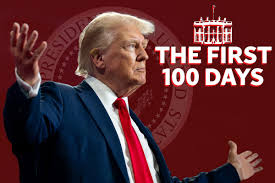
Trump’s First 100 Days: Executive Orders, Tariffs, and Foreign Policy Shifts​

Trump’s First 100 Days: Executive Orders Tariffs and Foreign Policy Shifts​

In his first 100 days back in office, President Donald Trump has aggressively pursued his “America First” agenda, implementing sweeping changes through executive orders, trade policies, and foreign relations.​ Executive Orders and Domestic PolicyPresident Trump has signed approximately 140 executive orders, nearly matching the total signed by President Biden during his four-year term. These orders have led to significant federal workforce reductions, with 280,000 job cuts, and a surge in deportations totaling 139,000 individuals. Trade Policies and TariffsTrump has imposed a 145% tariff on Chinese imports, prompting a retaliatory 125% tariff from China. These actions have raised concerns about a looming recession. Additionally, he announced 25% tariffs on imports from Mexico and Canada, effective February 1, marking a significant shift in North American trade policy. Foreign Policy and International RelationsThe administration’s foreign policy moves have included backing Russia’s claim over Crimea, re-engaging in the Gaza conflict, and straining relationships with traditional allies such as Canada and South Korea. Trump’s alignment with Russia’s narrative on Ukraine and his expansionist rhetoric have unsettled nations worldwide. ​Latest news & breaking headlines These actions have led to a fragmented world order and rising geopolitical instability, with U.S. allies re-evaluating their defense and economic strategies. ​Reuters As President Trump’s policies continue to unfold, both domestic and international observers are closely monitoring the implications for the United States and the global community.

Read More
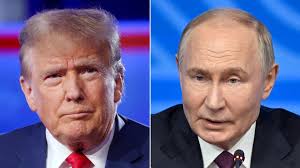
Vladimir Stop Trump Slams Russia Over Continued Strikes on Ukraine

Vladimir Stop Trump Slams Russia Over Continued Strikes on Ukraine

Former U.S. President Donald Trump has strongly criticized Russia’s ongoing military strikes on Ukraine, calling on President Vladimir Putin to end the aggression immediately. Trump’s remarks came during a rally in Ohio on Tuesday, where he addressed a wide range of foreign policy issues, including the ongoing war in Eastern Europe. Vladimir, stop! The world has seen enough bloodshed. What’s happening in Ukraine is unacceptable,” Trump said to a cheering crowd. He went on to describe the escalating conflict as a humanitarian disaster that “could have been avoided” with stronger leadership and diplomatic pressure. Trump, who has long touted his relationship with global leaders during his time in office, claimed that such a war would not have broken out under his administration. “When I was president, Russia knew its limits. They didn’t cross that line. We had peace through strength,” he added, reiterating his belief that his foreign policy approach kept global tensions in check. The former president’s comments mark a rare and direct condemnation of the Kremlin’s actions, as Trump has previously faced criticism for appearing too lenient toward Putin. However, Tuesday’s remarks signal a shift in tone, with Trump expressing deep concern for the Ukrainian people and the broader implications of continued Russian aggression. Meanwhile, the White House has yet to respond to Trump’s statement, but officials continue to affirm U.S. support for Ukraine. As the war enters another difficult phase, with mounting civilian casualties and infrastructure damage, international calls for a ceasefire are growing louder — and Trump’s voice has now joined that chorus.

Read More
Trump Says Some Undocumented Immigrants May Stay Based on Employer Recommendations

Trump Says Some Undocumented Immigrants May Stay Based on Employer Recommendations

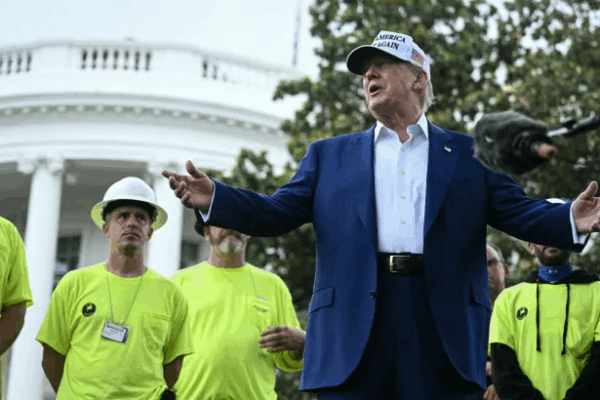
Trump put forward a proposal at Thursday, April 10, Cabinet meeting that might temporarily let certain undocumented immigrants to stay in the United States if they had significant support from their employers. This would be especially true in sectors like agriculture that are experiencing labor shortages. President Trump reportedly told farmers, “We’re also going to work with them that if they have strong recommendations for their farms for certain people, we’re going to let them stay in for a while and work with the farmers,” on Thursday, April 10, as reported by The Washington Times. Essential sectors like agriculture, hospitality, and others that depend on manual labor must have access to workers, he said. The president implied that these employees will formally apply for permanent residency status in due time. Following a meeting with Homeland Security Secretary Kristi Noem, who detailed the Trump administration’s plan for illegal aliens to self-deport, the president made the following statements Trump hinted that the proposal may change into a guest-worker program, which would sponsor the temporary stay and employment of specific persons in the nation by their businesses. “ A farmer will come in with a letter concerning certain people saying they’re great, they’re working hard,” said Trump. “We’re going to slow it down a bit for them and then we’re ultimately going to bring them back.” He did say that getting these people legal status would be the end aim, but that it would be a long road. According to the president, “We have to take care of our farmers and hotels and various places where they need the people.” This strategy is crucial in addressing labor shortages in important industries. This plan is an example of the continuous endeavor to find a middle ground between strict immigration enforcement and the practical needs of companies who are trying to fill open positions. According to Trump, the government is trying to find a way to aid businesses that rely largely on immigrant labor while also trying to rein in illegal immigration. Significant political and legal obstacles are anticipated to stand in the way of this plan’s implementation, and its specifics are still up in the air.

Read More
Trump administration officials accidentally text a reporter Yemen ‘war plans’

Trump administration officials accidentally text a reporter Yemen ‘war plans’

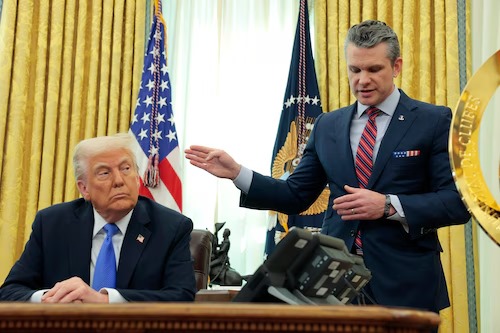
The White House has confirmed a report by The Atlantic’s editor-in-chief Jeffrey Goldberg, who says senior Trump administration officials accidentally included him in a Signal chat group in which they discussed plans to conduct strikes in Yemen Goldberg was included in a group chat in which US Defense Secretary Pete Hegseth and other top officials discussed upcoming strikes against Yemen’s Houthis. Trump announced strikes on March 15, but in a shocking security breach, Goldberg wrote that he had hours of advance notice via the group chat. “The message thread that was reported appears to be authentic, and we are reviewing how an inadvertent number was added to the chain,” National Security Council spokesman Brian Hughes told reporters. The security breach provoked outrage among Democratic lawmakers, including Senator Chris Coons, who wrote on X that “every single one of the government officials on this text chain have now committed a crime.” Signal, an open-source, encrypted messaging application, is not approved by the US government for sharing sensitive information.

Read More