Tinubu Suspends ADC Colonel Nurudeen Yusuf’s Promotion After Military Concerns

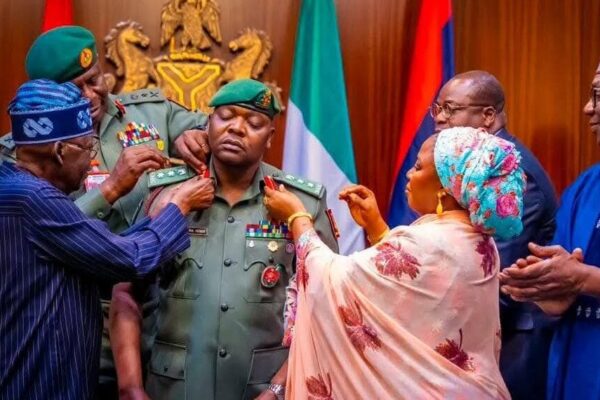
President Bola Tinubu has reportedly halted plans to fast-track a promotion for his Aide-de-Camp (ADC), Colonel Nurudeen Yusuf, following interventions by senior retired military officers, including two former Chiefs of Army Staff, according to military sources. Yusuf was reportedly set to be elevated to brigadier-general barely a year after his promotion to colonel in December 2024, with a quiet ceremony scheduled for Monday evening. The plan was reportedly shelved at the last minute over concerns about its impact on military discipline, seniority, and morale. Promotion to brigadier-general in the Nigerian Army is typically a highly competitive process. Officers are usually required to spend at least four years at the rank of colonel, complete senior military education at institutions such as the National Defence College or NIPSS Kuru, and pass rigorous promotion boards evaluating service records, command experience, and available vacancies. The proposed acceleration of Yusuf’s promotion was seen as a departure from these established norms. A leaked letter dated December 12, 2025, from the Office of the National Security Adviser, signed by Nuhu Ribadu, stated that Yusuf would continue to serve as the President’s ADC despite the proposed promotion. Sources also noted that no brigadier-general has previously served as ADC to a sitting Nigerian President, raising concerns within the Army hierarchy. Ahead of the planned ceremony, Defence Minister General Christopher Musa (retd.) and Chief of Army Staff Lt. Gen. Waidi Shaibu reportedly cut short an official trip to Lagos to return to Abuja. The decisive intervention, however, came from two widely respected former Army Chiefs who persuaded the President to suspend the promotion. A source within the Presidency confirmed that the elevation “would not happen anytime soon.” The decision coincided with a closed-door meeting between President Tinubu and Nigeria’s Service Chiefs at the Presidential Villa amid growing internal and regional security challenges. The meeting, which took place shortly after Tinubu attended a book presentation at the State House Conference Centre, was his first engagement with the full military high command since General Musa’s appointment as Defence Minister on December 4, signaling efforts to realign defence and security strategy under new leadership. While the agenda of the meeting was not disclosed, it came amid worsening insecurity, including the ongoing captivity of 115 students abducted from a Catholic boarding school in November. The President had earlier declared a national security emergency, ordered fresh recruitment into security agencies, and redeployed police personnel attached to private individuals to core duties. The meeting also followed Senate approval for the deployment of Nigerian troops to the Republic of Benin after an attempted coup, reflecting Nigeria’s expanding regional security responsibilities. Reports indicate discussions included internal security operations, intelligence coordination, border security, counterterrorism, and regional commitments. Though Yusuf’s promotion is on hold, the episode has reignited debates over the balance between presidential authority and military procedure. While exceptional promotions are not unprecedented, accelerating an officer to general rank is particularly sensitive, as it can affect seniority and morale. ADCs, given their proximity to the Commander-in-Chief, occupy a unique role focused on protective and administrative duties rather than command. “Military morale rests on the belief that everyone plays by the same rules,” a retired infantry officer said. “Once officers feel that access to power outweighs merit, cohesion suffers.” The controversy underscores the broader challenge for the Tinubu administration: exercising presidential authority in security matters while maintaining institutional confidence. In a military stretched by insurgency, banditry, and extensive deployments, perception can be as crucial as command. Whether the promotion is eventually confirmed or quietly abandoned, the episode highlights that in military affairs, the process of decision-making can be as important as the outcome itself.

Read More
Kebbi Governor Demands Explanation From Military Over Troop Withdrawal Before School Abduction

Kebbi Governor Demands Explanation From Military Over Troop Withdrawal Before School Abduction

Kebbi State Governor Nasir Idris has demanded answers from military authorities over the withdrawal of troops from Government Girls’ Comprehensive Secondary School, Maga, shortly before students and staff were abducted. The governor expressed serious concern that security personnel left the school despite prior intelligence alerts provided by the state government. He made the comments while receiving Nigeria Labour Congress President, Joe Ajaero, who visited the state in solidarity. According to Idris, soldiers reportedly left the school around 3:00 a.m., and the attack occurred less than 45 minutes later. “As a responsive government, when we received intelligence about a possible attack, we convened a security meeting. The agencies assured us that all was well and that personnel would be deployed to the school. The military was deployed, but they withdrew by 3 a.m., and by 3:45 a.m., the incident happened,” the governor said. He added that the state has called for a thorough investigation into the circumstances behind the troop withdrawal. “Who authorised the military to withdraw? How did security personnel leave at such a critical time? That is our concern. We have asked the military to investigate and identify who gave that order,” Idris said. The governor noted that the withdrawal was at odds with earlier assurances of strengthened protection for schools in high-risk border communities frequently targeted by bandits. He assured that both the state and federal governments are making every effort to secure the safe return of the abducted students. “Our duty as leaders is to ensure that our daughters come back home safely, and we are doing everything possible to achieve that,” he said.

Read More

Senate Approves Bill to Ban Recruitment of Under-18s into Nigerian Military

The Nigerian Senate has advanced the Armed Forces (Repeal and Re-enactment) Bill, 2025 for a second reading, signaling a major step toward prohibiting the recruitment of individuals under 18 into the country’s military. The bill, sponsored by Senator Abdulaziz Yar’Adua of Katsina Central, proposes repealing the Armed Forces Act of 2004 and replacing it with a modern framework that aligns with Nigeria’s democratic values and current security needs. The legislation also brings Nigeria’s military laws in line with international and regional child protection standards, including the Child Rights Act of 2003, the United Nations Convention on the Rights of the Child, and the African Charter on the Rights and Welfare of the Child. Senator Yar’Adua said the reform was long overdue, emphasizing that the existing law, rooted in a military-era decree, no longer reflects democratic principles. “Our armed forces are a symbol of unity and pride, but the laws guiding them have not evolved with our democracy. This bill rebuilds the military’s legal foundation to reflect justice, professionalism, and respect for human rights,” he said. In addition to banning underage enlistment, the bill introduces significant reforms, including clearer definitions of military offences, fairer punishments, and stronger protection for courts-martial by criminalising interference from superior officers — a measure aimed at preventing abuse of authority within the armed forces.

Read More

Nigeria Says Dozens of Gunmen Killed in Military Operations Across Northwest and Northeast

Nigeria’s military has reported killing dozens of armed men in separate operations across the country’s troubled northwest and northeast regions. In Katsina State, northwest Nigeria, authorities said security forces repelled coordinated attacks on multiple villages on Tuesday, killing at least 30 suspected gunmen. The state’s commissioner for internal affairs, Nasir Mua’zu, said the assailants were intercepted by troops and police after launching deadly raids that left a civilian, two soldiers, and three policemen dead. “Our gallant security forces successfully repelled the attackers. Thirty of the criminals were neutralised through coordinated air strikes as they attempted to escape,” Mua’zu said in a statement on Thursday. “We are working tirelessly with federal security agencies to ensure the safety of all citizens.” In a separate operation in the country’s northeast, the Nigerian Army said 24 insurgents were “neutralised” between July 4 and 9 during joint land and air offensives in Borno State, targeting fighters from Boko Haram and the Islamic State West Africa Province (ISWAP). “These coordinated operations were supported by close air support and local forces,” said Army spokesperson Reuben Kovangiya. “The operations underscore the determination of Operation Hadin Kai troops to place terrorists on the back foot and restore socioeconomic activities in the North East.” The northeast has been plagued by extremist violence since the Boko Haram insurgency erupted in 2009. Over 35,000 people have been killed and more than two million displaced, according to United Nations figures. Meanwhile, the northwest remains plagued by armed gangs involved in banditry and mass abductions. Despite occasional peace accords, including a recent one in Katsina with several bandit leaders, attacks and insecurity persist in the region. Nigerian military claims in similar operations have faced skepticism in the past, with independent verification often limited due to restricted media access to affected areas.

Read More

Army Chief Urges Youths to Join Military, Promotes Discipline and Patriotism in Sokoto Outreach

The Chief of Army Staff, Lieutenant General Olufemi Oluyede, has encouraged young Nigerians to consider careers in the Nigerian Army, emphasizing the values of discipline, patriotism, and national service. Speaking during a civil-military relations event held on Friday at Idris Koko Technical College, Farfaru, Sokoto, the Army Chief — represented by Brigadier General A. A. Musa, Commander of the 108 Division Equipment Service — said the initiative aimed to enlighten students about the Army’s nation-building role and inspire youth to pursue positive, purposeful lives. “It is our hope that through this initiative, more young Nigerians will consider a career in the Army and understand the importance of discipline, patriotism, and service to the nation,” General Musa said. The event featured educational talks and interactive sessions designed to bridge the gap between civilians and military personnel. Captain Musa Lemu, Administrative Officer at the 8 Provost Group, spoke on the dangers of criminal associations, urging students to focus on education and avoid peer pressure. Lieutenant E. O. Ojo delivered a presentation on “Civil-Military Relations and Community Interventions by the Nigerian Army,” highlighting the Army’s humanitarian outreach such as: Mallam Musa Koko, Director of Quality Assurance at the Sokoto State Ministry of Science and Technology, who represented the Commissioner for Basic and Secondary Education, applauded the Nigerian Army for the initiative. “Programs like this help our students to envision meaningful futures and inspire them to contribute to national development,” he stated. The event attracted wide participation from students, teachers, Army officers, and government officials, and ended with a lively Q&A session, giving students a chance to engage directly with military personnel and explore opportunities in national service.

Read More

Israeli Army Chief Links Strikes on Iran to Military Objectives in Gaza

Israel’s Chief of the General Staff, Lieutenant General Eyal Zamir, has stated that recent Israeli strikes on Iran may serve to advance the country’s military objectives in Gaza, raising fresh concerns over the widening scope of the ongoing conflict. Speaking during a field tour of Israeli military positions in Gaza on Friday, Zamir claimed that Iran “has taken a heavy blow,” suggesting that the attack could directly support Israel’s operations in the Palestinian territory. “This may advance our objectives in Gaza,” he said. The comments come in the aftermath of Israel’s conclusion of “Operation Rising Lion,” which the military claims targeted elements of Iran’s nuclear infrastructure. Zamir further commended Israeli ground forces operating in Gaza, stating that their combat experience was “a significant part of the [Israel Defense Forces]’ ability to act with force in Iran.” His remarks appear to blur the distinction between Israel’s military confrontations with Iran and its ongoing war in Gaza, drawing criticism from analysts who warn that linking both theaters of conflict could signal a dangerous escalation. Despite months of air and ground assaults that have resulted in the deaths of tens of thousands of Palestinians and widespread destruction across Gaza, Zamir admitted that Israel’s declared military objectives in the territory remain unfulfilled. The statement has further fueled international concern over the growing regional dimension of Israel’s war efforts and the humanitarian toll in Gaza.

Read More

Tinubu hails Military on North-West operations, pledges sustained support 

Nigeria’s President Bola Tinubu receives with relief the news of the strings of successful operations against security threats in the north-west by troops of the Nigerian military. He said the success of the operations gives further assurance that our security operatives are up to the task of  of ensuring the peace and security of the nation. Troops of Operation Hadarin Daji, on Thursday, neutralised a wanted bandit leader, Halilu Sububu, who had been unleashing terror on citizens in Zamfara, Sokoto, and other parts of north-western Nigeria. The troops also killed  another terrorist Sani Wala Burki in a Joint Operation in Katsina, and  busted a terrorist enclave in Kaduna, where 13 kidnapped students were freed. The successful operations follow the President’s directive to the service chiefs to relocate to the zone until normalcy is restored.  President Tinubu commends the military high command, the intelligence agencies, and the troops for their valiant efforts, synergy, and dedication, which have resulted in the recent laudable outcomes. The President also commended the entire security apparatus for the improved security in the nation and enjoins them to sustain their efforts until immediate and latent threats are permanently removed. President Tinubu reassured the security agencies of his continued support in achieving the priority objective of keeping the nation safe and secure.

Read More