
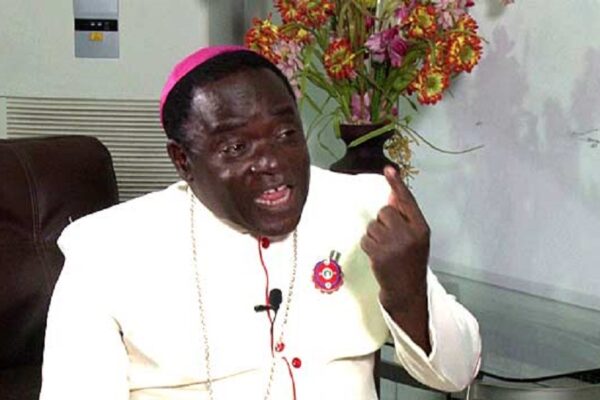
Matthew Kukah Denies Claims He Said Christians Are Not Persecuted In Nigeria

Matthew Kukah, Catholic Bishop of the Sokoto Diocese, has rejected claims that he denied the persecution of Christians in Nigeria, saying his comments were wrongly interpreted. The cleric spoke on Sunday while appearing on Boiling Point, a radio programme, where he addressed reports linking his remarks to the ongoing debate over religious violence and insecurity in the country. The controversy followed the decision by United States President Donald Trump on October 31 to redesignate Nigeria as a Country of Particular Concern (CPC) over allegations of systematic violations of religious freedom, including claims of a Christian genocide. The CPC label is applied to countries accused of “systematic, ongoing, egregious violations of religious freedom.” The Nigerian government has repeatedly dismissed allegations of a Christian genocide. However, in November, Trump warned that the United States could intervene militarily to protect Christians, after several US politicians continued to raise concerns about killings in Nigeria. On December 25, the US carried out airstrikes on two terrorist camps located in the Bauni forest area of Tangaza Local Government Area of Sokoto State. Clarifying his position, Kukah said his statements had been taken out of context. “I never denied the killing of our people [Christians],” he said. “I don’t want to go into the details of the mischaracterisation of what I said, but it shocked me that Christians were going around saying that I said there is no persecution of Christians in Nigeria. “The only clarification I can give is that I have never denied that there is persecution of Christians in Nigeria. Whether it’s persecution, whether it’s genocide, by God, this thing ought not to have happened. “Wherever we can get help from, Trump, whatever, these killings ought not to have happened in the first place.” Kukah also stressed that the security crisis in Nigeria affects citizens across religious lines, noting that no group is immune from the threat of violence and abduction. “In my central argument about security in Nigeria, it doesn’t matter where you are, whether you are Muslim, whether you are Christian, you are in danger of being abducted,” he said.
Read More

Bishop Kukah Says Christians Are Not Persecuted In Nigeria

The Catholic Bishop of Sokoto Diocese and Convener of the National Peace Committee, Most Rev. Matthew Kukah, has said there is no persecution of Christians in Nigeria, stressing that genocide is determined by intent, not by the number of casualties. Bishop Kukah recently faced criticism after reportedly urging the international community not to designate Nigeria as a “country of particular concern,” warning that such a label could heighten tensions, foster suspicion, and be exploited by criminals, ultimately undermining interfaith dialogue and cooperation with the government. Speaking at the 46th Supreme Convention of the Knights of St. Mulumba (KSM) in Kaduna, Kukah aligned himself with the Vatican Secretary of State, the President of the Catholic Bishops’ Conference of Nigeria, and other Catholic bishops regarding the issue of alleged attacks on Christians. “They are saying that 1,200 churches are burnt in Nigeria every year, and I ask myself—in which Nigeria? Interestingly, nobody approached the Catholic Church to get accurate data. We do not know where these figures came from. All those talking about persecution—has anyone ever called to ask, ‘Bishop Kukah, what is the situation?’ The data being circulated cleverly avoids the Catholic Church because they know Catholics do not indulge in hearsay,” he said. On the misuse of the term genocide, he explained, “Genocide is not based on the number of people killed. You can kill 10 million people and it still won’t amount to genocide. The critical determinant is intent—whether the aim is to eliminate a group of people. So, you don’t determine genocide by numbers; you determine it by intention. We need to be more clinical in the issues we discuss.” Challenging claims of Christian persecution, Kukah said, “If you are a Christian in Nigeria and you say you are persecuted, my question is: how? At least 80% of educated Nigerians are Christians, and up to 85% of the Nigerian economy is controlled by Christians. With such figures, how can anyone say Christians are being persecuted?” He blamed many of the challenges faced by Christians on internal disunity, saying, “The main problem is that Christians succumb to bullies. The day we decide to stand together—believing that an injury to one is an injury to all—these things will stop.” Kukah also cautioned against loose claims of martyrdom: “Because someone is killed in a church, does that automatically make them a martyr? Whether you are killed while stealing someone’s yam or attacked by bandits, does that qualify as martyrdom? I am worried because we must think more deeply.” Clarifying misconceptions about his previous remarks, he added, “People say there is genocide in Nigeria. What I presented at the Vatican was a 1,270-page study on genocide in Nigeria and elsewhere. My argument is that it is not accurate to claim there is genocide or martyrdom in Nigeria.” He urged members of the Knights of St. Mulumba to defend the Church through example, saying, “We are no longer talking about wielding swords, but about living as true witnesses.”

Read More