
Appeal Court Upholds Ban On VIO From Stopping Motorists Or Seizing Vehicles

The Court of Appeal in Abuja on Thursday upheld an earlier judgment that prohibits the Directorate of Road Traffic Services (DRTS) and Vehicle Inspection Officers (VIOs) from stopping motorists, seizing vehicles, or imposing fines on road users. In a unanimous ruling, a three-man panel dismissed the appeal filed by the VIO, describing it as lacking merit. The lead judgment, delivered by Justice Oyejoju Oyewumi, confirmed that there was no justification to overturn the Federal High Court’s decision of October 16, 2024, which had declared the actions of VIO officials against motorists unlawful. The original ruling was delivered by Justice Nkeonye Maha of the Federal High Court, who held that no existing law grants VIO officials the power to stop, impound, confiscate vehicles, or impose fines on motorists. The case, filed as a fundamental rights enforcement suit marked FHC/ABJ/CS/1695/2023, was instituted by public interest lawyer, Abubakar Marshal. He told the court that VIO operatives forcefully stopped him in the Jabi area of Abuja on December 12, 2023, and unlawfully confiscated his vehicle. Marshal asked the court to declare the actions of the officers illegal, oppressive, and a gross violation of his fundamental rights. In her judgment, Justice Maha granted all the reliefs sought and restrained the DRTS, its agents, and assigns from further impounding vehicles or imposing fines on motorists, describing such practices as unlawful and oppressive. The court also issued a perpetual injunction barring any future violation of Nigerians’ rights to freedom of movement, presumption of innocence, and the right to own property. Justice Maha ruled that only a court of competent jurisdiction has the authority to impose sanctions or fines on motorists. She further held that the respondents violated the applicant’s constitutional right to property under Section 42 of the 1999 Constitution (as amended) and Article 14 of the African Charter on Human and Peoples’ Rights. The judge stressed that the respondents lacked statutory powers to impound vehicles or impose fines, noting that their actions breached the rights to fair hearing, freedom of movement, and presumption of innocence guaranteed under Sections 6(6)(b), 36(1), 36(8), 36(12), 41 and 42 of the Constitution, as well as relevant provisions of the African Charter. Marshal, who was represented by a legal team led by Femi Falana (SAN), had demanded N500 million in damages and a public apology in three national newspapers. However, the court awarded him N2.5 million in damages. Those sued in the case included the DRTS, its Director, the Abuja Area Commander identified as Mr Leo, the team leader, Mr Solomon Onoja, and the Minister of the Federal Capital Territory. Following the judgment, the respondents challenged the decision at the Court of Appeal, but the appellate court dismissed their appeal on Thursday, thereby affirming the earlier ruling in its entirety.

Read More

Nnamdi Kanu’s Lawyer Vows to Appeal Life Sentence

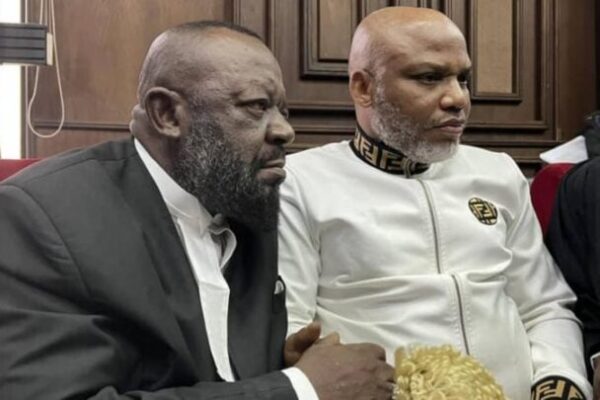
Aloy Ejimakor, lawyer to Nnamdi Kanu, has announced plans to appeal the Federal High Court ruling that sentenced the IPOB leader to life imprisonment. Speaking to journalists after Justice James Omotosho delivered the judgement on Thursday, Ejimakor described the verdict as a “travesty of justice” and said the defence team would take the matter to the Court of Appeal. Kanu was sentenced to life imprisonment on counts one, four, five, and six, while receiving 20 years for count three and five years for count seven. All sentences are to run concurrently without an option of a fine. Ejimakor criticised the ruling, saying it set a dangerous precedent and was inconsistent with the evidence presented in court. “This is the only day I have witnessed a man being convicted for mere pronouncements, just for what he said, not what he did with his own hands,” he said. He added: “The verdict is overbroad, cruel, and unusual. How can you convict a man for making a broadcast from a location that was never named, with no link to any specific incident of violence or terrorism?” Ejimakor stated that if the Court of Appeal upholds the ruling, the defence would proceed to the Supreme Court, asserting confidence that Kanu’s conviction would ultimately be overturned.

Read More

Appeal Court reaffirms Julius Abure as Labour Party Chairman

The Abuja Division of the Court of Appeal has reiterated that Julius Abure remains the National Chairman of the Labour Party (LP). A three-member panel of the appellate court in a judgement delivered by Justice Hamma Barka, held that its judgement of November 13, 2024, which recognised Abure as national chairman subsists and has not been set aside by any court. Barka made the declaration on Friday, while delivering judgement in two separate appeals filed by Senator Esther Nenadi Usman and the Caretaker Committee and the Independent National Electoral Commission (INEC). The appellate court in the two separate appeals held that it did not delve into the issue of the leadership of the Labour Party, because such issues are not justiciable. According to the appellate court, anything that is done outside jurisdiction amounts to a nullity. Hence the judgement of the Federal High Court delivered on October 8, 2024 by Justice Emeka Nwite is of no effect because it was delivered without jurisdiction. “We cannot say this appeal fails or succeeds because the lower court lacked jurisdiction to entertain the suit in the first place,” Barka held. While striking out the suit for want of jurisdiction, he held that the appellate relied on its previous judgement of November 13 last year to hold that “Abure Remains National Chairman of the Labour Party”.

Read More

Appeal Court affirms Amaewhule as Speaker of Rivers Assembly

The Court of Appeal sitting in Abuja, on Thursday, affirmed Hon. Martin Amaewhule as the valid Speaker of the Rivers State Assembly. It also validated the Amaewhule-led members of the Assembly as bonafide lawmakers for the state. The appellate court, in a unanimous decision by a three-member panel of Justices, dismissed an appeal that was lodged before it by Governor Siminalaye Fubara and upheld a judgement the Federal High Court delivered on January 22, which nullified the 2024 budget of Rivers State on the premise that it was not presented before members of the state assembly that were known to the law. According to the appellate court, Fubara, shot himself on the foot when he voluntarily withdrew a counter-affidavit he filed to challenge a legal action the Amaewhule-led lawmakers instituted to be recognised as valid members of the Rivers State House of Assembly. The court held that Fubara’s decision to present the 2024 Rivers State Appropriation Bill to only four out of 31 members of the Assembly, amounted to a gross violation of section 91 of the 1999 Constitution, as amended. It will be recalled that the Rivers State Assembly was fractionalised owing to the frosty relationship between Governor Fubara and his predecessor and Minister of the Federal Capital Territory, FCT, Nyesom Wike. In the heat of the fracas, governor Fubara sidelined the Amaewhule-led 26 members of the House that were loyal to Wike and presented the state’s N800billion 2024 budget before the four lawmakers led by Hon. Edison Ehie who had emerged as a factional Speaker of the Assembly. The Ehie-led faction, which had also declared seats of the Amaewhule-led pro-Wike lawmakers vacant for defecting to the All Progressives Congress, APC, from the Peoples Democratic Party, promptly passed the budget which was quickly assented to by Governor Fubara. Meanwhile, following the intervention of President Bola Tinubu, both Fubara and Wike signed a peace pact that included the restoration of Amaewhule as the bonafide Speaker of the State Assembly. Vanguard reports that the factional Speaker, Ehie, who had approached the court and was joined as an interested party in the suit, subsequently withdrew all the processes he filed before the court and equally rescinded both his seat and his membership of the Assembly. Whereas Governor Fubara, in line with terms of the peace deal, withdrew all the processes he filed to challenge the suit, however, the pro-Wike lawmakers only withdrew an impeachment notice they served on him while they declined to terminate their legal action. While deciding the suit, Justice James Omotosho of the high court held that the budget was invalid as it was not properly presented before the Rivers State House of Assembly as required by the law. It held that Governor Fubara acted like a tyrant when he demolished the Rivers State Assembly complex and withheld funds standing to the credit of the legislative house. The court also described as unconstitutional the redeployment of the Clerk and Deputy Clerk of the Rivers State Assembly by Governor Fubara. Justice Omotosho stressed that the governor lacked the statutory rights to interfere with the operations of the Assembly, adding that he acted in contempt of a subsisting order that barred the parties from taking any steps to overreach the matter that was pending before the court. Besides, the court held that the National Assembly could not take over the legislative affairs of the state in the absence of the preconditions that were listed under section 11 of the 1999 Constitution, as amended. Consequently, the court, among other things, nullified all actions the Rivers Assembly took without the participation of the Amaewhule-led members of the House, among which included the presentation of the state appropriation bill. It issued an order of injunction, restraining Governor Fubara from impeding or frustrating the operations of the Assembly under Amaewhule’s leadership as its speaker. It ordered the governor to release all funds standing to the credit of the Rivers State House of Assembly. While upholding the verdict of the lower court, the appellate court held that Fubara conceded to the Amaewhule-led lawmakers when he withdrew all the processes he filed against their suit. “A party must be consistent in the presentation of its case. A party cannot approbate and reprobate or blow hot and cold at the same time,” the appellate court held. It held that the orders of the trial court were appropriate given the circumstance of the case, saying the appeal Fubara filed before it amounted to an academic exercise. Accordingly, it ordered Fubara to pay a cost of N500,000 to each of the Respondents in the appeal marked: CA/ABJ/CV/133/2024.

Read More