Putin Visits India Amid Renewed Ukraine Peace Push — What’s on the Agenda?
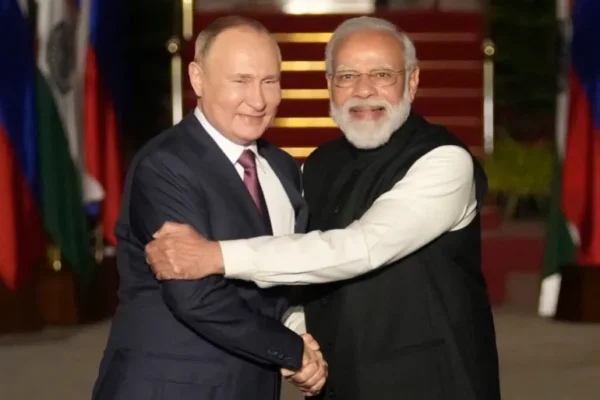
Russian President Vladimir Putin arrives in India on Thursday for a high-level diplomatic visit—his first trip to the country since Moscow launched its full-scale invasion of Ukraine nearly four years ago. The visit comes as the United States intensifies pressure on Russia to end the war, while also targeting India with tariffs and sanctions threats over its continued energy and defence ties with Moscow. Putin’s 30-hour working trip also coincides with rising tensions between Washington and New Delhi. The U.S. has recently imposed punitive tariffs on Indian goods and warned of sanctions because of India’s increased purchases of discounted Russian crude oil during the war. India’s Delicate Balancing Act India has long walked a tightrope between its deepening strategic partnership with the United States and its decades-old defence and diplomatic ties with Russia. Since independence in 1947, New Delhi has avoided formal alliances, leaning towards the Soviet Union during the Cold War before later strengthening ties with Washington in the post-Cold War era. But Russia’s invasion of Ukraine has placed enormous strain on that balancing act. Putin’s visit is now seen as a critical indicator of how Prime Minister Narendra Modi plans to manage these competing relationships without jeopardising crucial partnerships. Putin’s Schedule in New Delhi The Russian president will arrive Thursday evening and attend a private dinner with Modi at the Prime Minister’s residence. The Kremlin has described the visit as “of great importance,” noting that it provides an opportunity to review the “extensive agenda” of the Russia-India “special and privileged strategic partnership.” Putin is accompanied by Defence Minister Andrei Belousov, Rosoboronexport executives, and the heads of major sanctioned oil companies, including Rosneft and Gazprom Neft. Why the Timing Matters This year marks 25 years of the Russia-India Strategic Partnership, signed during Putin’s first year in office. But recent years have disrupted a previously consistent pattern of annual summits. 2022: Modi was scheduled to visit Russia, but the summit was cancelled following the Ukraine invasion. 2023: Putin skipped the G20 Summit in New Delhi amid the ICC arrest warrant. 2024: Modi travelled to Russia, reviving the summit tradition. 2025: Putin is now returning after a four-year gap. Defence and Trade Expected to Dominate Talks Analysts say Putin hopes to: Expand defence exports to India, including missile systems and fighter jets. Strengthen cooperation in pharmaceuticals, agriculture, machinery, and energy. Counter U.S. efforts to isolate Moscow. The visit offers significant political optics for Putin. “President Putin can send a message that Russia is not isolated,” said Rajan Kumar, professor at Jawaharlal Nehru University. However, discussions will unfold under the shadow of shifting global energy dynamics—and the growing assertiveness of U.S. President Donald Trump. The Trump Factor Following Russia’s invasion, India became the second-largest buyer of Russian crude, with imports surging by 2,250%. The U.S. initially tolerated the increase, arguing it helped stabilise global oil markets. But Trump now views India’s purchases as leverage over Moscow. He has: Imposed 50% tariffs on Indian goods as a penalty. Sanctioned Russia’s biggest oil firms, including Rosneft and Lukoil. Threatened sanctions on countries still trading with them. As a result: India’s imports of Russian crude are projected to fall to a three-year low. Reliance Industries, India’s largest refiner, has said it will stop exporting products made from Russian crude. India recently signed a major agreement to ramp up U.S. natural gas imports. Nevertheless, experts say India will not abandon Moscow entirely. Defence: The Strongest Pillar of India-Russia Ties Despite diversification into U.S. and European arms markets, Russia remains: India’s largest defence supplier (36% of imports) The source of over 60% of India’s military arsenal The partnership was further solidified during India’s four-day air conflict with Pakistan in May, when the Russian S-400 missile defence system played a crucial role. India is considering purchasing additional S-400 units. Russia is also keen to sell its Su-57 fifth-generation stealth fighter jets. “The SU-57 is the best plane in the world,” Putin’s spokesman Dmitry Peskov said before the visit. “And it will be on the agenda.”