Kamal Yalwa

Absence of NMA Medical Report Stalls Nnamdi Kanu’s Terrorism Trial

ABUJA — Justice James Omotosho of the Federal High Court, Abuja, on Wednesday adjourned the terrorism trial of the leader of the Indigenous People of Biafra (IPOB), Nnamdi Kanu, to October 16, 2025, pending the submission of a medical report by the Nigerian Medical Association (NMA), News360 Nigeria reports. The adjournment followed the NMA’s failure to submit its court-ordered medical report on Kanu’s health condition. At the previous sitting, Justice Omotosho had directed the NMA President to constitute a panel of medical experts to assess Kanu’s alleged deteriorating health and present their findings to the court. The examination was expected to determine whether the Department of State Services (DSS) medical facility could adequately handle Kanu’s treatment or if he should be transferred to the National Hospital, Abuja, as requested by his legal team. The report would also help the court establish whether Kanu is medically fit to continue standing trial. However, during Wednesday’s proceedings, DSS counsel, Suraj S’aad, SAN, informed the court that the NMA medical board had communicated that its report was not yet ready for submission. S’aad consequently applied for a one-week adjournment to allow the medical board to conclude its review and finalise the report. With no objection from the defence, Justice Omotosho granted the request and adjourned the case to October 16, 2025, for the NMA board to present its findings and for the court to determine the next line of proceedings.
Read More

FCT Court Arraigns Lawyers Victor Giwa, Ibitade Bukola for Alleged Forgery, Impersonation

Two Abuja-based lawyers, Victor Giwa and Ibitade Bukola, were on Tuesday arraigned before the High Court of the Federal Capital Territory (FCT), Apo Division, on charges of alleged forgery and impersonation. The duo are facing a three-count charge bordering on criminal conspiracy to commit forgery, false personation, and fraudulent execution of documents. According to the charge sheet, the offences were allegedly committed on June 28, 2024, when Giwa and Bukola purportedly forged a letter using the official letterhead of Awa U. Kalu (SAN) and addressed it to the Attorney General of the Federation (AGF). The forged document, titled “Urgent and Solemn Appeal to Suspend the Arraignment of Our Colleague Victor Giwa on Charge Number: CR/222/2023,” allegedly sought to influence the AGF to halt Giwa’s scheduled arraignment before Justice Samira Bature of the FCT High Court, Maitama. The case, presided over by Justice Jude Onwuegbuzie, was previously stalled on September 15, 2025, leading to a bench warrant for Giwa’s arrest. His co-defendant, Bukola, who had been at large, appeared in court for the first time on Tuesday. During proceedings, Prosecution Counsel Asaph Eristo informed the court that the session was for arraignment. Both defendants pleaded not guilty to the charges. Eristo urged the court to remand the defendants to prevent interference with ongoing investigations. However, Edwin Anikpenu, SAN, counsel to the defence, applied for bail, arguing that both defendants are legal practitioners and that Bukola is a nursing mother. He sought to orally amend Giwa’s existing bail application to include Bukola. Justice Onwuegbuzie expressed displeasure at the oral request, criticising the defence team for failing to file a formal bail application despite being represented by over a dozen lawyers. “It is shocking that a lawyer, a Senior Advocate, would come with an oral application and attempt to add another defendant without documentation. With 13 lawyers present, none deemed it fit to file a proper bail application,” the judge remarked. The court subsequently refused bail for Bukola and ordered that she be remanded at the Suleja Correctional Facility in Niger State. Regarding Giwa, the defence urged the court to grant bail on self-recognition or release him to a senior member of the Nigerian Bar Association (NBA), Garki Branch. The prosecution opposed the request, claiming Giwa posed a flight risk and that public funds were used to effect his arrest. After hearing both sides, Justice Onwuegbuzie granted Victor Giwa bail in the sum of ₦30 million, with two sureties in like sum. The sureties must be civil servants not below Grade Level 16, reside in Abuja, possess valid ID cards, and submit their international passports. The case was adjourned to October 15, 2025, for continuation of trial. Also present in court were A.A. Askira of the Civil Liberty Committee of the NBA, who watched briefs for the defendants, and Levi Nwonye, Esq., representing the nominal complainant.

Read More

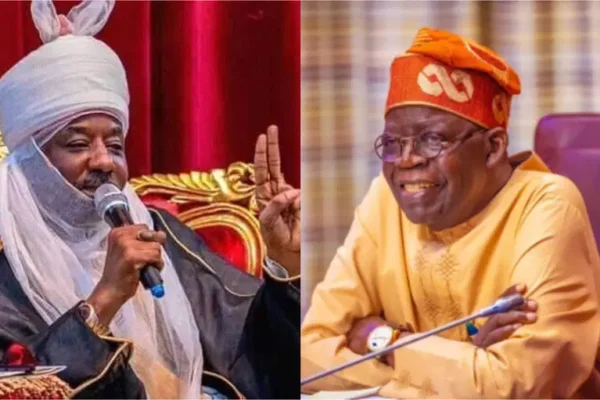
Emir Sanusi Backs 80% of Tinubu’s Policies, Flags Concerns Over Fiscal Spending, Food Importation

The Emir of Kano and former Governor of the Central Bank of Nigeria (CBN), Muhammad Sanusi II, has expressed strong support for most of President Bola Tinubu’s economic policies, while voicing concerns over the government’s fiscal management and approach to food importation. Speaking in an interview with News Central on Tuesday, Sanusi commended the Tinubu administration for stabilising Nigeria’s economy through improved fiscal discipline and more coherent monetary policy coordination. “In terms of monetary policy and stability, I have nothing but commendation for the government. On the fiscal side, we have had an improvement in revenue-to-GDP ratios, improvement in debt service ratios, and a contraction in the deficit. These are positive steps, but we still have a long way to go,” he said. While applauding progress in revenue generation, the former CBN governor urged the federal government to prioritise the quality and efficiency of public expenditure. “We’re still spending too much money on government—on the cost of governance, too many political appointees, too many officers,” Sanusi said. “If we do not improve the quality of spending and put a rein on expenditure, we’re going to continue borrowing.” Sanusi warned that Nigeria risks falling back into a debt trap if savings from the removal of fuel subsidies are not managed prudently. “After saving money from these expensive subsidies, after building up the government balance sheet, you go and spend it, and then you have to borrow again,” he cautioned. On food security, the Emir criticised the recent wave of food importation, arguing that it undermines local farmers and threatens long-term agricultural development. “I would like to see that we put a stop to the mass importation of food. I know it was driven by a desire to bring down food prices, but it is, in the end, very counterproductive to domestic production and domestic producer prices,” he said. Sanusi urged the government to strengthen the agricultural value chain and invest in domestic production to achieve sustainable food security. “Hopefully, we will get to a point where we go back on track with the reforms in the agricultural sector—fixing the agricultural value chain and relying on domestic production to feed the nation,” he added. Summing up his assessment, Sanusi said the Tinubu administration had made significant strides despite the country’s ongoing economic challenges.

Read More

Traditional Rulers Have No Constitutional Powers to Impose Bans

Let’s be clear: traditional rulers in Nigeria have no constitutional authority to impose or enforce bans. Their functions are largely symbolic, advisory, cultural, and mediatory, particularly on issues related to customs, festivals, and community traditions. If a traditional ruler desires that a particular policy or restriction be made law, the proper democratic process is to present the proposal to the State House of Assembly, where it can be debated and, if found appropriate, passed into law by elected representatives of the people. In the present case, concerned residents of Lagos State should seriously consider challenging such actions in court to reinforce the principle that traditional institutions have no legal power to issue enforceable directives. This issue goes beyond one community or ruler—it is about upholding constitutional order and democratic accountability. Lagos, as Nigeria’s most cosmopolitan and economically vital state, must not set a precedent that allows unelected individuals to wield powers reserved for elected officials. Allowing such practices to stand risks blurring the line between cultural authority and constitutional governance, a development that could undermine both democracy and the rule of law.

Read More

Sanwo-Olu to Commission 420 Housing Units in Ajara, Badagry

Sanwo-Olu to Commission 420 Housing Units in Ajara, BadagryGovernor Babajide Sanwo-Olu of Lagos State will on Wednesday, October 8, 2025, commission the newly completed Ajara Housing Estate Phase 1 in Badagry, comprising 420 home units. The new estate is expected to boost Lagos State’s housing stock and provide accommodation for over 2,000 residents, further advancing the government’s goal of delivering affordable and quality homes to Lagosians. Speaking during a media briefing on Tuesday, the Commissioner for Housing, Hon. Moruf Akinderu-Fatai, said the estate consists of a mix of one-bedroom, two-bedroom, and three-bedroom apartments, designed to meet the diverse housing needs of residents. Akinderu-Fatai noted that the project’s completion aligns with Governor Sanwo-Olu’s campaign commitment to finish all ongoing housing projects across the state. “The Ajara Housing Estate represents another milestone in our quest to make decent and affordable housing accessible to Lagos residents,” the commissioner said. “We are excited about its completion because it will also stimulate the local economy in Badagry.” He expressed appreciation to prospective homeowners for their patience and trust in the administration throughout the project’s duration. The commissioner also cautioned members of the public against dealing with unauthorised agents or middlemen, stressing that the Ministry of Housing does not engage agents in the sale of its housing units. “Interested applicants should visit the Estate Department of the Ministry at Block 3, the Secretariat, Alausa, Ikeja, for legitimate information and subscription processes,” he advised.

Read More
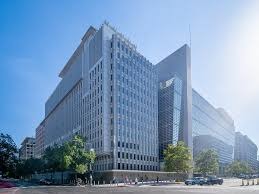
World Bank Approves $632m Loan for Nigeria.

World Bank Says Nigeria’s Single-Digit Inflation Target Unrealistic

The World Bank has described the Federal Government’s ambition to achieve single-digit inflation in the short term as unrealistic, warning that Nigeria remains among a handful of African countries still struggling with high consumer prices. In its latest Africa’s Pulse Report, released on Tuesday, the global lender projected that Nigeria, Angola, Ethiopia, Ghana, Malawi, Sudan, Zambia, São Tomé and Príncipe, and Zimbabwe will continue to experience double-digit inflation through 2025. According to the report, while 37 of Africa’s 47 economies are on track to maintain single-digit inflation by 2026, Nigeria remains an outlier due to persistent structural challenges, including currency depreciation, high food and energy costs, and supply chain bottlenecks that continue to fuel price instability. The projection contrasts with repeated assurances from government officials — including Finance Minister Wale Edun and CBN Governor Olayemi Cardoso — who have maintained that ongoing fiscal and monetary reforms will soon bring inflation down to single digits. At the recent CBN Governor’s Annual Lecture Series in Lagos, Cardoso reaffirmed that achieving single-digit inflation remains a medium-term target, despite current headline inflation hovering above 20 per cent. However, the World Bank report noted that while inflation across Sub-Saharan Africa is easing — with the region’s median inflation rate falling from 9.3 per cent in 2022 to 4.5 per cent in 2024 — Nigeria continues to lag behind its peers. “In 2025, nearly 60 per cent of Sub-Saharan African countries will experience a slowdown in inflation, but nine nations, including Nigeria, are still expected to record double-digit rates,” the report stated. The Bank also projected that Sub-Saharan Africa’s economy will grow by 3.8 per cent in 2025 and average 4.4 per cent between 2026 and 2027, driven by improved commodity prices and investment inflows. Nigeria’s growth forecast was revised upward by 0.6 percentage points, buoyed by rising oil production and modest capital inflows. Nonetheless, inflation remains a key threat to consumer spending and business confidence. “Nigeria’s inflation trajectory continues to undermine consumer demand and macroeconomic stability,” the report added, warning that structural bottlenecks and exchange rate pass-through effects remain major constraints. The World Bank’s Chief Economist for Africa, Andrew Dabalen, observed that while countries like Kenya, Tanzania, and Côte d’Ivoire have managed to keep inflation within single digits through prudent fiscal management and stable exchange rates, Nigeria’s case remains “particularly challenging.” The report further cautioned that despite Africa’s overall economic resilience, regional growth remains insufficient to generate enough decent jobs for its expanding population. It urged governments to focus on reducing business costs, strengthening institutions, and promoting private sector investment.

Read More

Argentine Police Arrest Nigerian Fugitive Wanted by INTERPOL in Landmark Cybercrime Case

Argentine authorities have arrested a Nigerian national, Ikechukwu N., marking the country’s first-ever capture of a fugitive listed on both INTERPOL’s Red and Silver Notices. The suspect is accused of masterminding a series of large-scale romance scams that defrauded thousands of women across multiple countries, as well as leading an international cybercrime network. The arrest was made under Operation Jackal, an INTERPOL-coordinated initiative targeting West African organized crime syndicates. The operation was conducted jointly by Argentina’s Federal Police (@PFAOficial) and Airport Security Police (@seguridadpsa), with crucial support from INTERPOL’s Financial Crime and Anti-Corruption Centre (IFCACC), FIS, and INTERPOL Brazil. The INTERPOL Silver Notice, introduced in January 2025 as a pilot project, is designed to help member countries trace, freeze, and recover criminal assets linked to transnational crime. This milestone arrest underscores Argentina’s growing role in global efforts to combat cyber-enabled financial crimes and strengthen international cooperation against organized criminal networks.

Read More

Cooking Gas Prices May Ease as NLNG, Major Offtakers Intensify Supply

Consumers of Liquefied Petroleum Gas (LPG), popularly known as cooking gas, may soon experience some relief as major offtakers with purchase agreements from the Nigeria Liquefied Natural Gas (NLNG) Limited have ramped up product loading to address recent shortages and price hikes. Findings by our correspondent revealed that NIPCO Gas and 11 Plc Gas resumed LPG offtake from the NLNG last Friday, with loading operations expected to intensify from Monday night to restore adequate distribution across the country. However, uncertainty still looms over how soon the market will stabilise, according to key operators in the LPG sector who spoke to our correspondent under condition of anonymity. A senior official of a major LPG marketing association disclosed that depot operators involved in LPG importation incurred heavy losses following the commencement of LPG production by the Dangote Refinery, which initially caused a price drop. He noted that the refinery was forced to suspend LPG production after a brief protest by the Petroleum and Natural Gas Senior Staff Association of Nigeria (PENGASSAN), adding that Dangote’s limited storage capacity for LPG further complicated supply. “The refinery focuses more on petrol and aviation fuel. So once production stopped, there was no buffer to sustain supply,” the source said. Another industry source revealed that normalisation of supply could take until the coming weekend.“LPG loading is not like petrol. We can’t load more than 25 trucks overnight because of safety protocols and documentation. But since loading has resumed, prices across Lagos and other Southwest states should start dropping soon,” the source explained. Meanwhile, several consumers have lamented the soaring cost of cooking gas.“My husband bought cooking gas at ₦2,000 per kilogramme,” one consumer told our correspondent.Another, who travelled from Agege to Ikeja to purchase gas, said: “In Agege, gas costs ₦2,500 per kilogramme. Here near Oba-Akran, it’s ₦1,500. Before now, it used to be ₦1,100.” Ajayi Abayomi, a senior official at a gas station in the Anifowoshe area of Oba-Akran, Ikeja, confirmed their current price of ₦1,500 per kilogramme, attributing the surge to supply disruptions. “There’s no other reason than limited supply,” he said. “The gas we’re selling now was diverted from our Port Harcourt operations to ensure our customers don’t run out. Normally, we source from Dangote Refinery or Apapa, but recent disruptions have made that difficult.” Abayomi also linked the hike to the PENGASSAN–Dangote Refinery dispute, which disrupted gas discharge operations in Apapa. “Once Dangote stopped selling, other suppliers increased prices. We just pass the cost to consumers,” he explained. LEADERSHIP recalls that in January 2022, NLNG committed to supplying 100 per cent of its Butane (cooking gas) and Propane production to the Nigerian domestic market to enhance availability and affordability. This commitment, part of the company’s Domestic LPG (DLPG) scheme, supports the federal government’s “Decade of Gas” initiative and reduces dependence on imported LPG. The NLNG remains Nigeria’s largest single supplier of LPG and has reaffirmed its collaboration with stakeholders to stabilise pricing and ensure long-term market sustainability.

Read More