Ukrainian Intelligence Confirms Two Nigerians Killed While Fighting As Russian Mercenaries
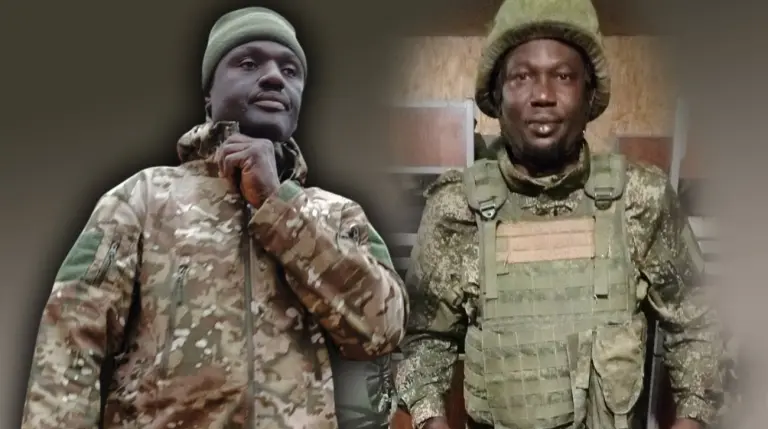
Ukrainian Defence Intelligence (UDI) has confirmed that two Nigerian men, Hamzat Kazeem Kolawole and Mbah Stephen Udoka, were killed while fighting for Russian forces in Ukraine.
The announcement comes amid repeated Russian denials that Nigerians are being recruited to fight on the frontlines. Russian Ambassador to Nigeria, Andrey Podyolyshev, told reporters in Abuja on Tuesday that he had no knowledge of any government-backed programme involving Nigerians and insisted that any such activity, if it exists, is not connected to the Russian state.
On Thursday, UDI released photographs showing the two Nigerians who died in the Luhansk region. The agency said both men served in the 423rd Guards Motor Rifle Regiment (unit 91701) of the 4th Guards Kantemirovskaya Tank Division of the Russian Armed Forces. Kolawole signed a contract on August 29, 2025, while Udoka joined on September 28, 2025.
According to UDI, Udoka received no military training and was deployed to Ukrainian territory just five days after signing. Kolawole’s training records are missing, but it is believed he also had minimal preparation. Kolawole leaves behind a wife and three children in Nigeria.
Both men were killed in late November during an attempted assault on Ukrainian positions. UDI noted that “they never engaged in a firefight — the mercenaries were eliminated by a drone strike.” The agency warned foreign nationals against traveling to Russia, stating that doing so carries the risk of being forced into frontline combat and ultimately killed.
This is part of a broader pattern. DAILY NIGERIAN previously reported that four other Nigerians — Adam Anas, Akinlawon Tunde Quyuum, Abugu Stanley Onyeka, and Balogun Ridwan Adisa — were killed in Ukraine after being recruited under the guise of “security jobs.” They underwent only three weeks of training before deployment between December 2025 and January 2026.
Sources said the Russian Embassy in Abuja issued the recruits single-entry tourist visas without biometric capture or other standard requirements. Once in Russia, they were allegedly forced into military service, made to sign contracts in Russian without translation or legal counsel, and had their passports confiscated, preventing them from leaving.