
Tinubu Suspends ADC Colonel Nurudeen Yusuf’s Promotion After Military Concerns
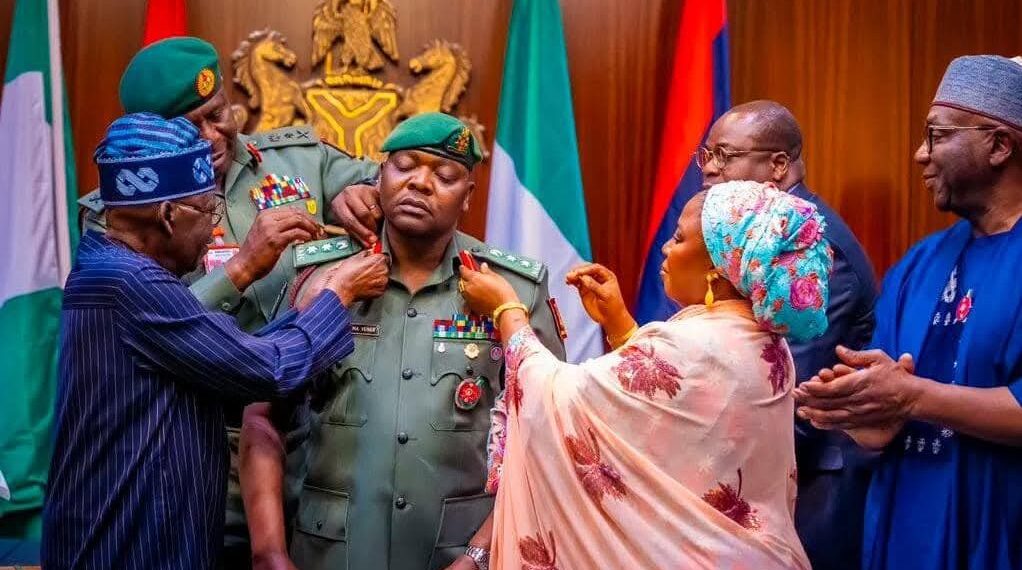
President Bola Tinubu has reportedly halted plans to fast-track a promotion for his Aide-de-Camp (ADC), Colonel Nurudeen Yusuf, following interventions by senior retired military officers, including two former Chiefs of Army Staff, according to military sources.
Yusuf was reportedly set to be elevated to brigadier-general barely a year after his promotion to colonel in December 2024, with a quiet ceremony scheduled for Monday evening. The plan was reportedly shelved at the last minute over concerns about its impact on military discipline, seniority, and morale.
Promotion to brigadier-general in the Nigerian Army is typically a highly competitive process. Officers are usually required to spend at least four years at the rank of colonel, complete senior military education at institutions such as the National Defence College or NIPSS Kuru, and pass rigorous promotion boards evaluating service records, command experience, and available vacancies. The proposed acceleration of Yusuf’s promotion was seen as a departure from these established norms.
A leaked letter dated December 12, 2025, from the Office of the National Security Adviser, signed by Nuhu Ribadu, stated that Yusuf would continue to serve as the President’s ADC despite the proposed promotion. Sources also noted that no brigadier-general has previously served as ADC to a sitting Nigerian President, raising concerns within the Army hierarchy.
Ahead of the planned ceremony, Defence Minister General Christopher Musa (retd.) and Chief of Army Staff Lt. Gen. Waidi Shaibu reportedly cut short an official trip to Lagos to return to Abuja. The decisive intervention, however, came from two widely respected former Army Chiefs who persuaded the President to suspend the promotion. A source within the Presidency confirmed that the elevation “would not happen anytime soon.”
The decision coincided with a closed-door meeting between President Tinubu and Nigeria’s Service Chiefs at the Presidential Villa amid growing internal and regional security challenges. The meeting, which took place shortly after Tinubu attended a book presentation at the State House Conference Centre, was his first engagement with the full military high command since General Musa’s appointment as Defence Minister on December 4, signaling efforts to realign defence and security strategy under new leadership.
While the agenda of the meeting was not disclosed, it came amid worsening insecurity, including the ongoing captivity of 115 students abducted from a Catholic boarding school in November. The President had earlier declared a national security emergency, ordered fresh recruitment into security agencies, and redeployed police personnel attached to private individuals to core duties.
The meeting also followed Senate approval for the deployment of Nigerian troops to the Republic of Benin after an attempted coup, reflecting Nigeria’s expanding regional security responsibilities. Reports indicate discussions included internal security operations, intelligence coordination, border security, counterterrorism, and regional commitments.
Though Yusuf’s promotion is on hold, the episode has reignited debates over the balance between presidential authority and military procedure. While exceptional promotions are not unprecedented, accelerating an officer to general rank is particularly sensitive, as it can affect seniority and morale.
ADCs, given their proximity to the Commander-in-Chief, occupy a unique role focused on protective and administrative duties rather than command. “Military morale rests on the belief that everyone plays by the same rules,” a retired infantry officer said. “Once officers feel that access to power outweighs merit, cohesion suffers.”
The controversy underscores the broader challenge for the Tinubu administration: exercising presidential authority in security matters while maintaining institutional confidence. In a military stretched by insurgency, banditry, and extensive deployments, perception can be as crucial as command.
Whether the promotion is eventually confirmed or quietly abandoned, the episode highlights that in military affairs, the process of decision-making can be as important as the outcome itself.